

College Basketball’s Canaries Are Falling Ill
As the nation’s best teams prep for the Final Four, others are waving the white flag. It’s a healthy surrender, even if some coaches and administrators can’t stomach it.


Welcome back to Club Sportico, where we discuss the intersection of sports and money—with humor and opinion. Today we’re talking about teams that will never make the Final Four.
By most measures, the Campbell University men’s basketball team has been an unremarkable program.
Since joining Division I in 1977, Campbell has played in five different conferences and qualified for just one NCAA Tournament, losing in the first round as a No. 16 seed in 1992. The team has never been ranked and has won 20+ games just twice in the past 50 seasons.
The Fighting Camels are a perfect proxy for D-I’s lower class—a school that doesn’t have an FBS football team and spends less on men’s basketball ($2.2 million) than some Final Four players make in annual NIL money. There’s dozens of other Campbells around the country that you’ve likely never heard of.
The team caught our attention this week when first-year head coach John Andrzejek resigned via social media. In a long post on X, Andrzejek said the school had “made the decision” to deprioritize basketball.
“Despite months of intense work and collaboration with AD Hannah Bazemore and our terrific athletics administration, and several creative options that were proposed and thoroughly explored, there are no pathways that the institution will support to fund the program appropriately moving forward,” he wrote to fans.
“Simply put—the institution now has different priorities, and they are not compatible with putting the kind of team on the floor that you deserve.”
But realistically, what kind of men’s basketball team—and at what cost?—does Campbell University deserve?
Andrzejek joined Campbell last year after two seasons as an assistant at Florida, helping the Gators win a national championship. Prior to that, he’d been an assistant at Johns Hopkins, then Dartmouth, then Washington State. His move to the Fighting Camels was the logical next step in what had historically been a familiar career path for many young up-and-coming coaches: rise up the ranks as an assistant, then start back near the bottom to rise up the ranks as a head coach.
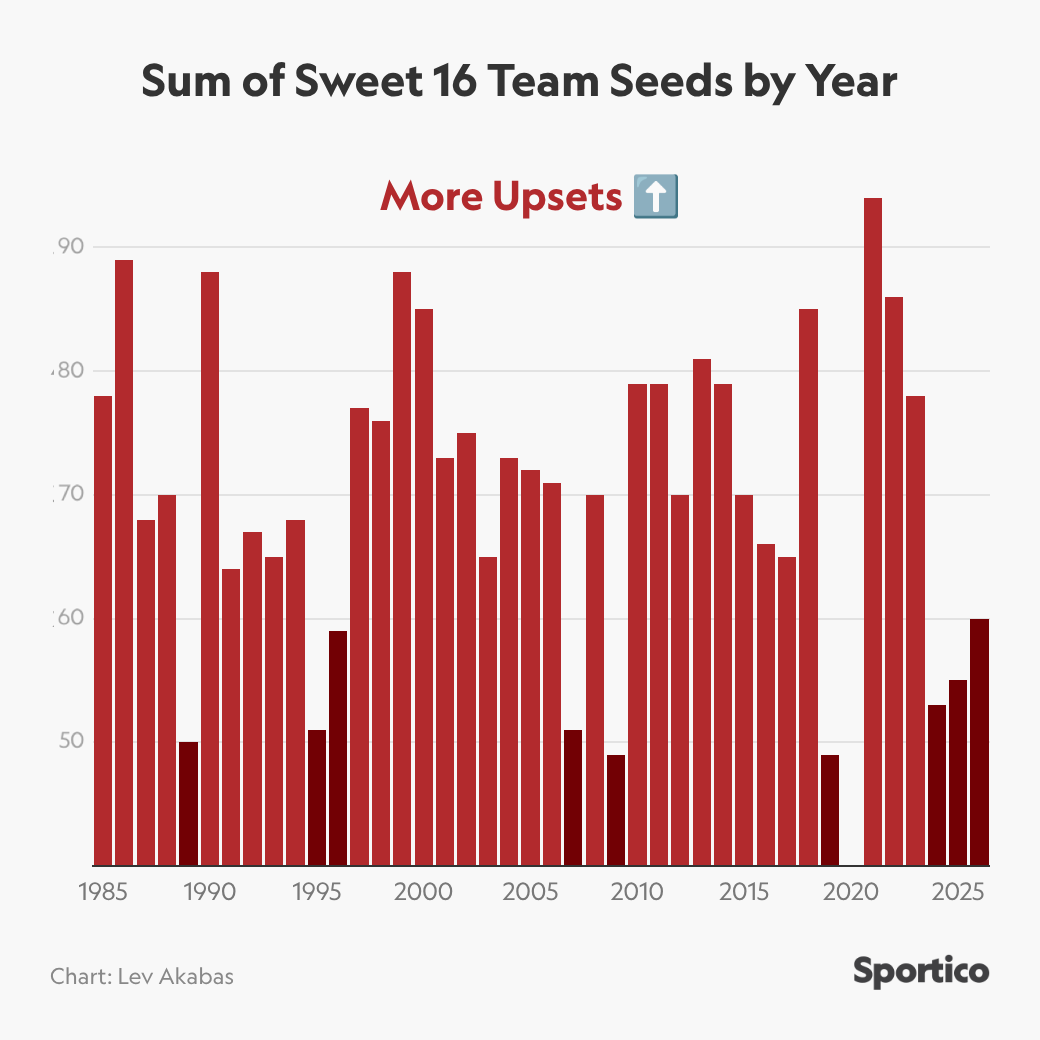
Except college basketball is fracturing in new ways. Revenue sharing, transfer freedom and NIL deals have accelerated the separation of the sport’s richer and poorer programs. That appears clear in recent March Madness tournaments, where good teams are winning at historically high rates.
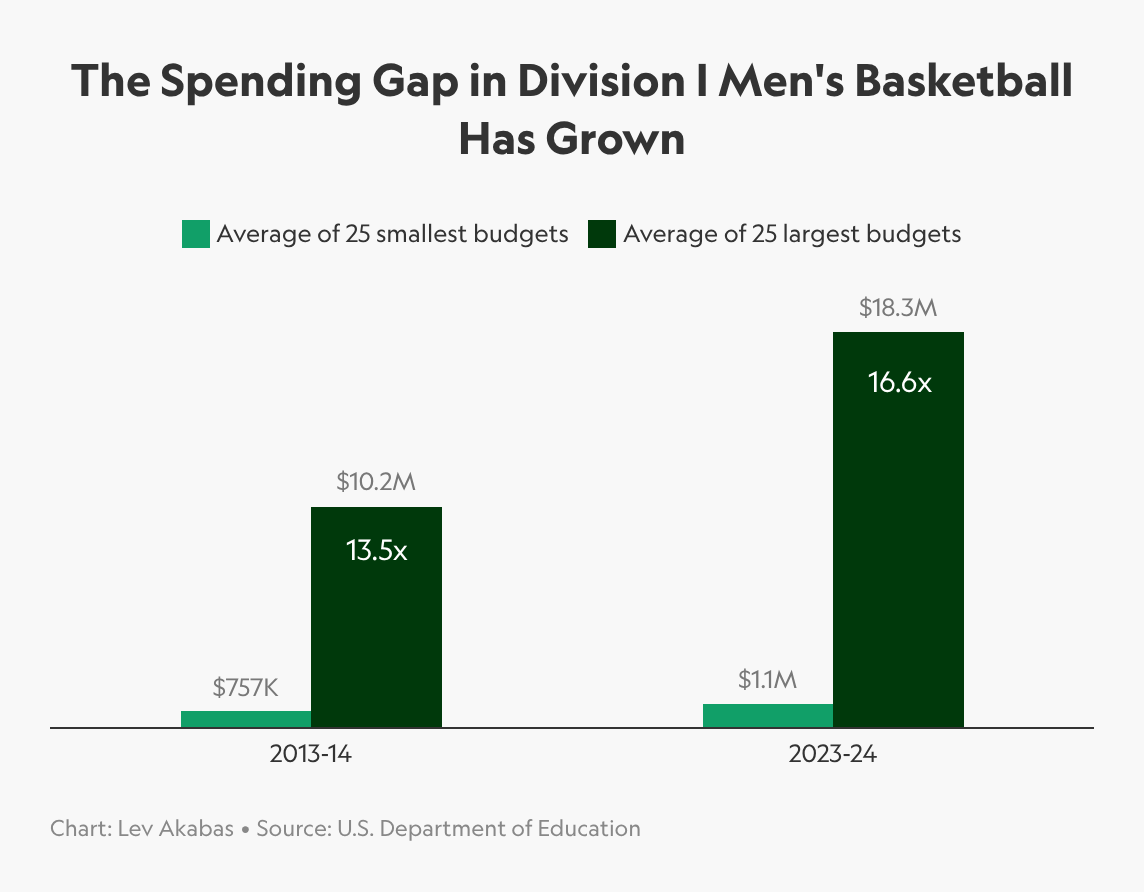
It’s also clear in spending. In 2014, the 30 biggest budgets in D-I men’s basketball were on average 13.5x bigger than the 30 smallest. Ten years later, the gap was 16.6x.1 I expect it’s even wider today.
One of the more enjoyable things about college basketball historically has been its relatively smooth sliding scale of talent and optimism. There have always been richer and poorer programs, but it was a hierarchy that felt climbable, and fans could calibrate their expectations accordingly. While some programs expected to annually compete for the national title, others could hope the stars might align in March for an upset or two. In the same way that talented coaches like Andrzejek followed that uphill climb, so too did athletes, who could play their way from a junior college onto a lower D-I roster, or from a lower D-I roster to a Power Five school.
Unlike a coach’s movement, however, player ascendency was artificially slowed. Coaches could bounce from one team to another year-in and year-out, but up until 2021, players had to sit out a year for most transfers. It slowed their upward mobility enough to keep that gradual scale.
Starting two years ago the transfer restrictions basically disappeared entirely, one of many changes forced by a prominent antitrust challenge. That change, more than anything, has been the death knell for schools like Campbell.2 Recruiting wins now last only a year. Good players are poached quickly by teams that offer way more money. Roster continuity has largely disappeared. It has many D-I programs rethinking what they’re trying to accomplish in college basketball.
And that’s a good thing! It might not be good for Andrzejek, who is giving up his head coach track to become an assistant at ACC powerhouse Louisville, or for Campbell fans who dream of March Madness glory. But it’s good for players and it’s probably good for the school.
More universities should be backing out of the financial arms race that is top-tier college basketball, and there’s evidence that they are. ESPN reported this week that St. Bonaventure would pay its new head coach about half as much as his predecessor. That’s so the team can adapt to the modern realities of college sports without additionally taxing its budget.
Others, of course, are struggling with this new reality. After Akron head coach John Groce left to take the same job at the College of Charleston, Zips AD Andrew Goodrich told the Akron Beacon Journal that the coach’s departure was due to Charleston’s willingness to share more revenue with its basketball players.
The following day, in a comment dripping with irony, Charleston athletic director Matt Roberts went on a heated rant about his program.
“If money is your main motivator, you’re not wanted at the College of Charleston,” Roberts said. “And that’s a direct message to those student athletes.”
Clearly he wasn’t talking about his new coach!
Fifteen seconds later, as if reminded by a voice in his head, Roberts added the classic college sports traditionalist’s caveat: “I love the fact that these kids get financial payments. But as an industry, what we’ve allowed—kids going to four different schools in four years—what are we doing?”
What college basketball is doing is changing, likely irreversibly. It might be time for schools like Charleston and leaders like Roberts to do the same.

On the most recent Sporticast episode, Eben, Scott and Kurt Badenhausen discussed the 50 highest-paid athletes of all time 👇

Club Sportico is a community organized by Sportico, a digital media company launched in 2020 to cover the business side of sports. You can read breaking news, smart analysis, and in-depth features from Eben, Jacob and their colleagues at Sportico.com, and listen to the Sporticast podcast wherever you get your audio. Contact us at club@sportico.com.
Campbell ranked 198th in 2014, per data with the U.S. Department of Education. It ranked 260th in 2024.
Here’s what UConn women’s coach Geno Auriemma said this week: “The [transfer] portal and the revenue share, I think that was the death of the mid-majors.”