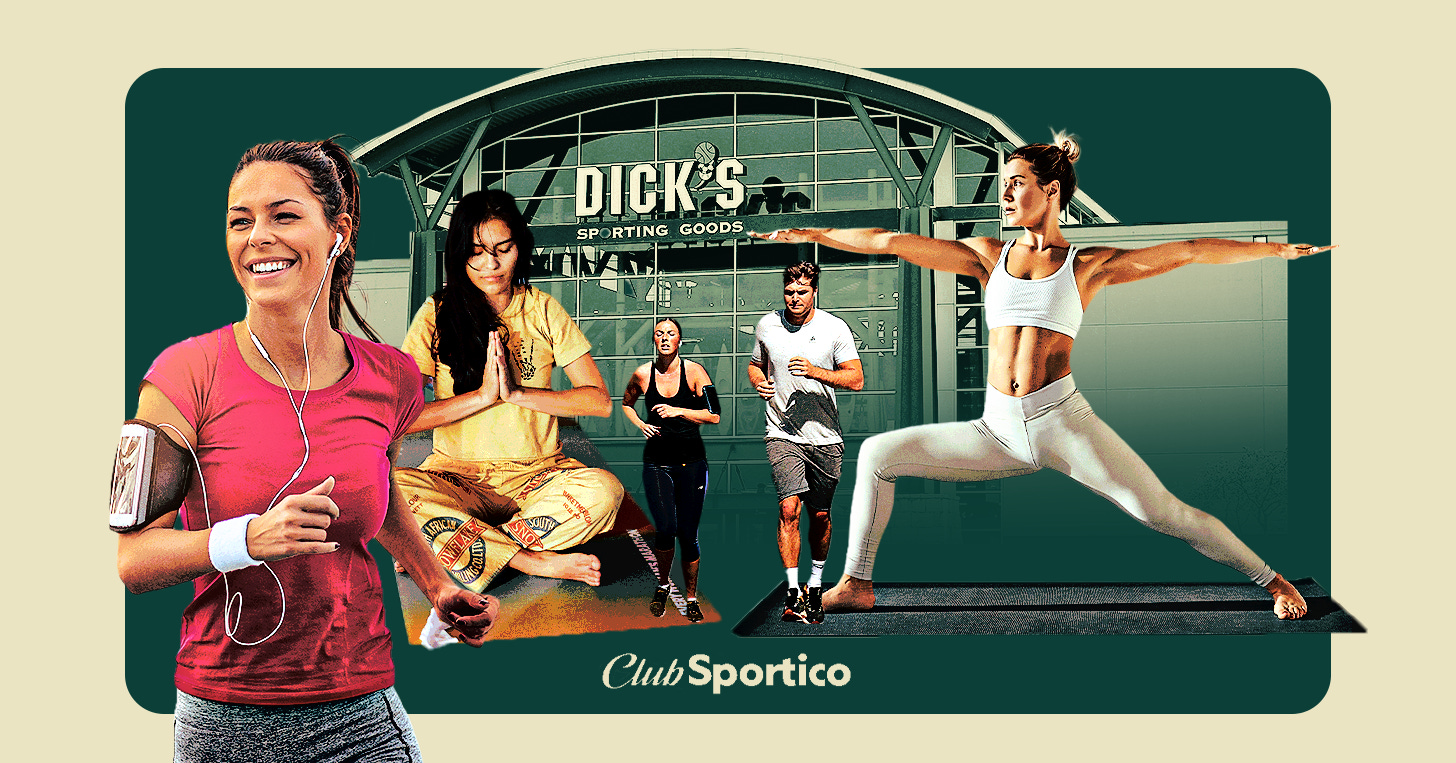
Dick’s will pay you pennies for your data
In its quest to become more than a big box retailer for sports gear, Dick's is looking for information on how you work out.
Welcome back to Club Sportico, where we break down the intersection of sports and money—with an extra bit of humor and opinion. Today we’re talking about a growing sports tech company, Dick’s Sporting Goods.
If you took a glance earlier this week at the most downloaded apps in the Apple App Store, you would have seen an immediate outlier tucked between AI agents like Claude, ChatGPT and Google Gemini.
Dick’s Sporting Goods seemed to gain traction over the past two weeks because of a series of viral—and probably organic?—social media posts informing people that the sports retailer would pay them for working out. Here’s an example 👇
On its face, it’s an enticing proposition. If you’re already active, you can get paid for doing what you’re already doing! Each day, users can earn three points for moving three miles, taking 10,000 steps or exercising for 30 minutes. Easy! Once you hit 300 points, you get a $10 credit.
Framed another way, if you want to order this Nike running t-shirt for free, you only have to work out every single day for more than two years. You’ll still pay taxes and shipping.
In return for those points, Dick’s is getting access to boatloads of longitudinal data about its customers: who you are, where you live, how you like to work out, what types of activities you prefer, and how dedicated you are. All of that is useful in helping Dick’s better sell you product. It could inform inventory decisions, apparel placement in stores, digital marketing spend, and give Dick’s more targeted purchasing power via wholesale partners like Nike or Hoka. It might also give the company direction on how to develop its private brands, like Calia and DSG, which give Dick’s better unit economics.
What’s more, that data is likely merged with other inputs from the retailer’s ScoreCard rewards program and fed into a relatively new business vertical that the company calls the Dick’s Media Network. That’s the retailer’s advertising arm where its data—including customer info and purchasing habits—is monetized to help other brands reach Dick’s consumers. That could be via a video board in its stores, or inside its online shop, email blasts or social media posts.
Here’s some of the info Dick’s says it gathers about its customers 👇
Dick’s executives are constantly hyping this growing data opportunity. At a Goldman Sachs retail conference back in September, CFO Navdeep Gupta said “nobody” has an athlete database that rivals that of Dick’s.
“We are uniquely positioned to be able to leverage that data,” Gupta said.
It’s a smart move for Dick’s, which is trying to position itself as something more than a big box retailer for sports equipment. The company has reimagined many of its suburban stores to be more experiential, a place where kids and adults can play in addition to shop. Dick’s has also made inroads into youth sports tech—Dick’s owns GameChanger, an app that lets parents and coaches stream games, keep stats, and manage teams.
The data emphasis is blend of those two initiatives. It both expands people’s definition of Dick’s, and it bolsters a revenue stream beyond the selling of t-shirts and soccer balls. The stock market has been volatile over the last few years, but Dick’s has been a strong performer. Shares (NYSE: DKS) are up nearly 3x in the past five years 📈
It feels like everything in our economy is shifting towards gamified rewards. What started with airline and gas station loyalty programs has ballooned into a key pillar of modern business strategy, and sports is a perfect microcosm of the trend. Sportsbooks and casinos have perfected the practice; Fanatics is trying to make a rewards platform that covers anything a fan might want to buy; the NBA has a fan loyalty program; and individual teams are finally waking up to their own opportunity. The Dick’s rewards platform, ScoreCard1, has more than 25 million members.
Underpinning all of these efforts is an insatiable thirst for user data, which is harvested throughout the chain. To get the data to Dick’s, users are already giving it to the tracking device that records it—Fitbit, Apple Watch or Garmin. And those companies are also monetizing this information in their own (possibly far more cynical) ways. Long before it was bought by Google, for example, Fitbit was using customer data to feed its enterprise health platform, which let employers push the trackers in exchange for the ability to monitor employee progress, health and activity.
The Dick’s privacy policy appears to have just one very vague line about user fitness data 👇
This is, in many ways, the real truth behind the growing preponderance of loyalty rewards programs. The gamification makes it feel less transactional, and that stickiness produces a startling amount of monetizable information, data that many U.S. consumers value personally at $0 three Dick’s points.
Jacob’s 🔥 Take: This all just makes me wonder when the ChatGPT rewards program is coming…
On the most recent Sporticast episode, Eben and Scott debate whether an upcoming Atlanta Hawks theme night, a celebration of a famous local strip club called Magic City, is a bad idea 👇
Club Sportico is a community organized by Sportico, a digital media company launched in 2020 to cover the business side of sports. You can read breaking news, smart analysis, and in-depth features from Eben, Jacob and their colleagues at Sportico.com, and listen to the Sporticast podcast wherever you get your audio. Contact us at club@sportico.com.
Separate from the workout rewards, ScoreCard members earn a point for every $1 spent at Dick’s. Once again, 300 points is worth a $10 dollar credit. There’s also Gold tier with added benefits, and a Dick’s ScoreRewards credit card that offers even more points.