

FIFA’s $4B Selloff Is About Buying More Power
England and Spain hate Gianni Infantino's new investment plan. But FIFA doesn't need support from its largest, most prominent members.

Welcome back to Club Sportico, where we discuss the intersection of sports and money—with some extra humor and opinion. Today we’re talking about what’s really going on with FIFA.
In the middle of his pre-World Cup press conference, sitting in front of dozens of journalists itching to ask about France, Spain and Argentina, Gianni Infantino made a point to shout out the sport’s less celebrated teams.
“For me as FIFA president, it is important that we invest in all the countries where nobody wants to invest,” he said. “Who’s investing in South Sudan? Who’s investing in Sierra Leone? Who’s investing in Bhutan or in East Timor or in Vanuatu? Nobody. We do it.”
Thirty minutes later he hit the point again. “The income allows FIFA to invest in all of these countries where otherwise nobody would invest,” he said. “If nobody thinks of them, well we do. We do think of the majority that doesn’t speak, that doesn’t have a voice, that doesn’t have anything. In FIFA they have a vote.”
Despite what he may want you to believe, Infantino is no philanthropist, and his organization’s distributions are not altruism. Yes, the millions that FIFA gives annually to its poorest members have undoubtedly done some good in those countries, but they have also served an invaluable service to Infantino, keeping him for years as the most powerful person in the world’s most popular sport.
And now he’s testing the limits of that power.
FIFA is a collection of 211 member nations, and as Infantino said last month, its governance gives each of them an equal voice in major decisions. That means the Cook Islands and San Marino (combined population of 49,000 and no World Cup appearances) have the same voting power as Brazil and Germany (300 million people, nine World Cup titles).
That’s important context for understanding the story that rocked global soccer this week. FIFA on Tuesday announced its intention to sell a significant stake in its revenue-generating operations. The organization wants to create a new commercial entity, worth $20 billion, and sell a passive 21% equity stake in the business to outside investors. That would create a cash infusion of roughly $4 billion.
According to multiple reports, the private equity firm run by Joshua Kushner, brother of Donald Trump’s son-in-law Jared Kushner, is in advanced talks to lead the funding. That obviously struck a chord with many around the world who were wary about Infantino’s cozy relationship with Trump leading up to the event and felt vindicated in those fears when the U.S. president inserted himself in Flo Balogun’s red card saga.
The backlash was swift, with criticism citing the plan, the process and the proposed investor. UEFA, the continental governing body for FIFA’s 53 European members, has said it will boycott en masse all FIFA events until the plan is dead and FIFA promises in writing to never revive it.1 CONCACAF, the governing body for North America, Central America and the Caribbean, held an emergency meeting on Thursday and then said its 41 members reject the proposal due to “deep concerns about the lack of due process surrounding the proposal, the artificially short deadline imposed, and the absence of any review or approval by the relevant FIFA governance bodies.” Other national and regional governing bodies offered slightly more equivocating concerns.
New U.K. prime minister Andy Burnham took to X to say that “The World Cup is not a product.” Then he called for Infantino’s job. Even Infantino’s predecessor, a man who resigned in 2015 amid a torrent of corruption accusations and investigations, spoke out against the proposal.

FIFA has responded with defiance.2 It has blended these talks with those surrounding the expansion of the men’s World Cup to 64 teams3, and is pushing forward with its plan to have members vote on the proposal by Sept. 19. That relatively arbitrary deadline has become another sticking point, with many members claiming that the whole process is being rushed without proper diligence and transparency.
To entice members, Infantino is doing exactly what you’d expect: dangling money. Under the old plan, members were set to receive $8 million in distributions in this upcoming four-year cycle. Should Infantino’s sell-off happen, that would jump to $20 million, plus an opportunity for another $20 million for special projects.
For the richest FIFA members, that difference might not move the needle. U.S. Soccer, for example, reported revenue of more than $455 million in just the last two years. But for all those smaller nations, the ones that hold the same vote as the U.S.—and would receive the same payout, regardless of World Cup participation—that money is a panacea.
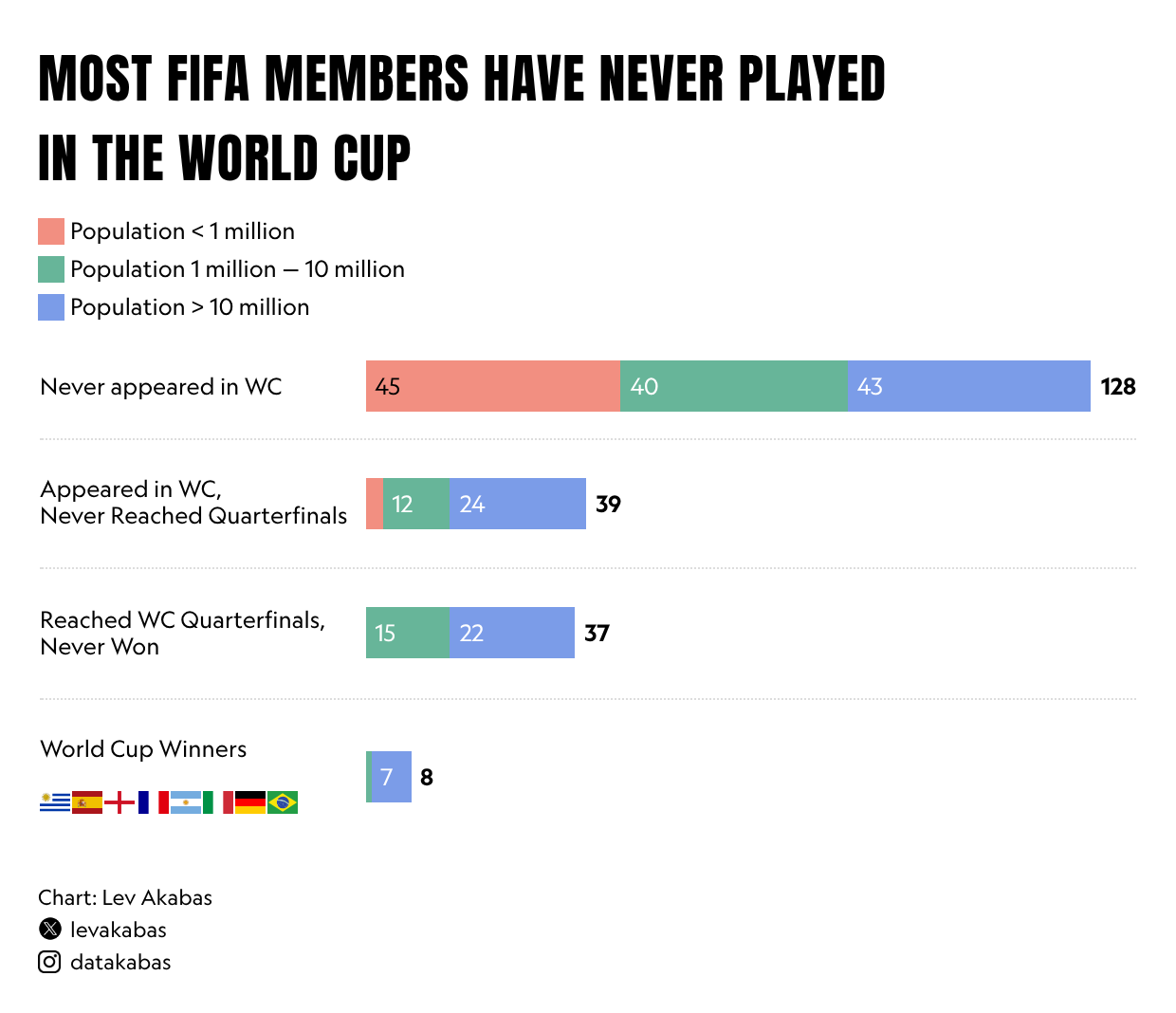
And that’s what Infantino is banking on: enough of those countries seeing the prospect of $40 million, instead of $8 million, and voting to approve the selloff. This plan may reek to soccer executives in the U.S., England, Spain and Argentina, but they’re less relevant in Infantino’s calculation. There are more FIFA members with a population under 5 million (84) than members that have played in the World Cup since WWII (82). There are more FIFA members with a population under 50,000—equivalent to a medium-sized Manhattan neighborhood—than there are members that have won a World Cup.4
FIFA technically only needs the votes of every country smaller than Kyrgyzstan. Alternatively, if Infantino could secure a Yes from every country that has never played in a single men’s World Cup, this plan would pass in overwhelming fashion.
There have been open questions about whether Infantino intends to enrich himself directly as part of this deal. He says no—and that maybe be true, but it’s also irrelevant. The fear of what this investment does to global soccer isn’t about the 21% passive investment, it’s about what Infantino and his allies (including the Trump family) might do after buying all this goodwill.
This strategy has worked in the past. Read anything about the major FIFA corruption scandals of the past two decades, and the playbook is clear. Global soccer leaders have used financial aid and development grants to small nations to push through initiatives and cover up inappropriate business dealings. Until he pled guilty to racketeering, wire fraud and money laundering, former CONCACAF president Jeffrey Webb was one of the sport’s most powerful (and most feted) people because of his ability to whip up votes from small Caribbean nations like Montserrat, Barbados and Dominica.5
What’s different today is that many of the globe’s smallest countries appear to be joining their larger ones in protest—at least for now. UEFA’s most powerful nations may be the big ones, but it also has members like San Marino, Gibraltar, and Cyprus. CONCACAF similarly has all those small island nations.
We’ll see if they remain loyal to the broader message as the vote gets closer. That $40 million is an enticing proposition. Gianni Infantino is banking on it.

Club Sportico is a community organized by Sportico, a digital media company launched in 2020 to cover the business side of sports. You can read breaking news, smart analysis, and in-depth features from Eben, Jacob and their colleagues at Sportico.com, and listen to the Sporticast podcast wherever you get your audio. Contact us at club@sportico.com.
The next big FIFA event is the U-20 Women’s World Cup, which is scheduled to kick off in Poland next month.
At least as of 1 PM ET on 7/31.
This plan is way more popular.
We obviously also have to address corruption, which runs in the background of everything happing in global soccer. Even assuming those smaller national governing bodies will use this money on the up and up—a laughable assumption, to be clear—it’s not hard to see why the dangle of this money might look so attractive. Now toss in the obvious and well-documented corruption that often occurs in governing bodies of that size, and the appeal to soccer leaders in many countries is even more obvious.
When Webb posted $10 million bond back in 2015, he did so by using 11 luxury watches, a diamond ring, three luxury sports cars and 10 different real estate properties.