
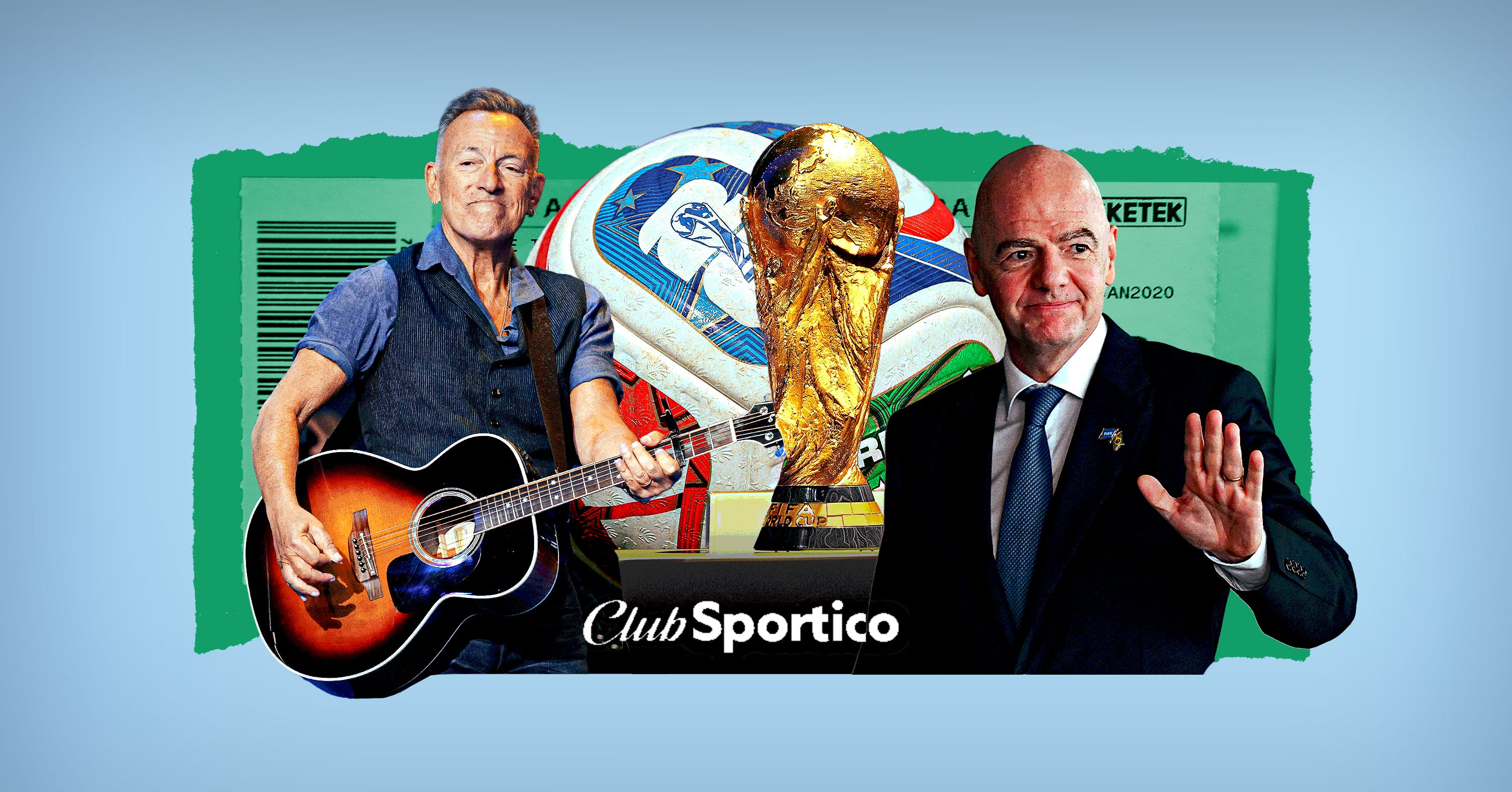
What Bruce Springsteen Taught Me About World Cup Tickets
The ongoing shift in ticketing is apparent everywhere from the World Cup to Bruce Springsteen's tour. But there's one major difference between them.
Welcome back to Club Sportico, where we discuss the intersection of sports and money—with humor and opinion. Today we’re talking about two very different bosses 🎸 ⚽.
Back in February, a few friends and I made plans to see Bruce Springsteen in concert in Pittsburgh. We put the May 19 date on the calendar, locked in housing, and quickly secured flights from New York. But we delayed perhaps the most important step—buying the actual concert tickets.
When we first looked, resale prices seemed unnecessarily high. Perhaps more notably, there were thousands of primary tickets still for sale at face value. We decided to wait.
Over the next few months we came close to buying multiple times, but at every check-in the underlying facts remained. Resale tickets felt expensive, and there were a ton of cheaper primary seats that remained unsold. And as the weeks went by, the face value for those tickets started to drop.
In April, we almost bought a block of primary tickets toward the back of the lower bowl for $509 each. On May 4th, when the face value dropped to $334, we discussed again. On May 12th, one week before the show, we almost bought slightly better seats for $267. Again, we passed. In the end, we bought tickets direct from the venue, on the morning of the concert, for $240.
I’ve been buying Bruce Springsteen tickets for 20 years, and it’s never been like this. For most of that stretch, I battled with thousands of other fans (and countless bots) to secure primary tickets in the seconds after they hit the market. If that failed, I scanned resale sites like StubHub or SeatGeek looking for deals. It was rare if a show didn’t sell out in minutes; it was inconceivable that there would be unsold primary tickets on the day of the event itself.
But ticketing is changing drastically. Instead of that massive ticket dump, premium concerts and sporting events now favor a slower, higher-priced approach. Initial on-sale prices are high, inventory is gradually released and the market adjusts over months, not days. Brokers’ arbitrage opportunities on the secondary market are diminished, and there are face value tickets available for much longer. Seven hours before Game 2 of the Knicks-Cavaliers Eastern Conference Finals on Thursday, for example, there were still hundreds of MSG tickets available at the Garden.
There are benefits and drawbacks here for fans. Tickets are initially priced at crazy numbers, making it expensive to plan ahead. This also means that a musical act or team’s most avid fans often end up being gouged the most. Sometimes, a venue will sell out even at those initial numbers, in which case, good luck1. In other instances, like that Springsteen show, prices come down to what they likely would have been in the older structure. The tickets we ultimately bought probably cost what they would have been listed for initially a decade ago—and we didn’t need four computers frantically refreshing at 9:01 AM to buy them.
If you’ve read anything about the upcoming World Cup in North America, there’s a good chance you’ve read about the tickets. High prices have become the story of the tournament so far. And on its face, it appears FIFA is doing something similar to Bruce Springsteen. Despite more than 500 million (!) ticket requests earlier this year from around the world, there are scores of seats still unsold. Many people have pointed to those unsold tickets as proof that FIFA botched its strategy. The truth is that this is the strategy. FIFA’s main goal is to make as much money as possible; there’s very little extra consideration for access or affordability.
My guess is that the World Cup market and the Bruce Springsteen market will ultimately differ in one critical way. Over the past few months, The Boss’s tour dropped its prices. They were high at the start, but as tickets remained unsold, organizers adjusted. I would bet the tickets we eventually bought direct from the venue for $240 were once listed for more than double that total.
Some of that is a desire to ultimately fill the building, but some of it is also a nod to the fans and the optics of extractive pricing. Bruce wants his fans to care about his tours and wants a large portion of them to be able to see him live2. He might tour again in a few years, and he’ll want those same people to once again fill arenas and stadiums.
FIFA has no such impetus. It’s been 32 years since the World Cup was in the U.S. and it might be another three decades before it returns. Many people buying tickets are fans of a specific national team; none are fans of FIFA. It allows the governing body to be as avaricious as possible with its ticket prices. The long-term consequences for an event that’s held once every four years, in a completely different part of the globe, are relatively minor.
And despite what you may have read elsewhere, I’m yet to see evidence that FIFA is willing to actually lower primary prices to any matches. That could mean everything eventually sells for the initial price. I’m more inclined to believe that FIFA will find ways to unload unsold inventory more quietly, either into the secondary market or privately to partners and sponsors.
But don’t take it from me, take it from the organization itself. In a moment of deep irony, FIFA boss Gianni Infantino addressed the ticket controversy earlier this month at the Milken conference, where business titans often pay $75,000 for a badge. On stage at that event, he said that if the tickets were priced cheaper they would have just ended up on the secondary market at the current prices3.
“We are in the market in which entertainment is the most developed in the world,” Infantino said, “so we have to apply market rates.”
Jacob’s ⚡ Take: Here’s my bull case for waiting to buy World Cup tickets: It’s true that FIFA has less incentive to appease its fans than a touring artist or domestic team might. But it also has less incentive to artificially keep the market inflated. Sports franchises often quietly move unsold tickets to sponsors or discounters so that ticket-buyers (and season-ticket holders in particular) don’t get annoyed that they spent more than they had to … or decide to skip the early sale period for future events. Those dynamics aren’t in play here. In the days leading up to a match, I wouldn’t be surprised to see FIFA take what it can get for unsold seats.
The bear case? There are a lot of people now waiting to see if prices drop—me (and probably you) included. That means they’re unlikely to come down by much…
We also discussed World Cup ticketing on a recent Sporticast episode 🎙️👇
Club Sportico is a community organized by Sportico, a digital media company launched in 2020 to cover the business side of sports. You can read breaking news, smart analysis, and in-depth features from Eben, Jacob and their colleagues at Sportico.com, and listen to the Sporticast podcast wherever you get your audio. Contact us at club@sportico.com.
This appears to be happening with Ariana Grande’s upcoming tour.
That said, he is undeniably a capitalist, despite constantly singing about “debts that no honest man can pay.”
He also said some insane shit about college football ticket prices.


