

The Lakers Are a Massive Bet on AI Disruption
Joshua Kushner is buying the Lakers because sports are relatively insulated from the economic havoc looming from the rest of his portfolio. That's not a hedge against AI, it's a doubling down.

Welcome back to Club Sportico, where we discuss the intersection of sports and money—with some extra humor and opinion. Today we’re talking about a reverse hedge.
It happened less than three days ago and I already feel there’s nothing new to say about the Los Angeles Lakers sale. Many people—some informed, some not—rushed to try to explain a story that is not yet actually explainable.
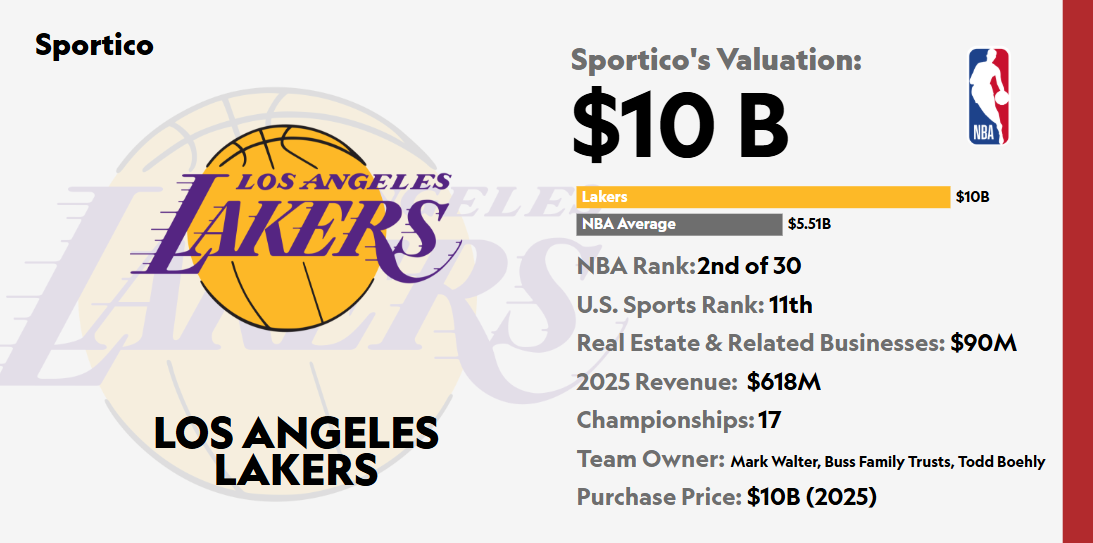
The details are undoubtably juicy. Seller Mark Walter is the target of federal investigations. Buyer Joshua Kushner is a tech billionaire and Trump family adjacent. The $12.5 billion sticker is the highest price ever paid for a sports team, eclipsing the $10 billion that Walter paid for the Lakers just eight months ago. There are fun tax implications, conspiracy theories and dubious records. Kushner will likely be the youngest control owner in the NBA; Walter will be the league’s shortest-tenured owner.
And at some point we’ll have answers on how much of that intrigue is actually relevant. Will Walter fire sale the Dodgers and his Chelsea stake? Is he laying the groundwork to go to Trump for help? How are Kushner and Bob Iger, who have a combined net worth of about $6 billion, going to finance this deal? We’ll get answers to all those questions, but they won’t come today.
For now, here’s one thing I do know:
Sports ownership is changing rapidly. Kushner is an early example of what will likely be a whole new class of billionaire buyers, and there’s an underlying cynicism to their interest.
Sports team sales tend to reflect what’s happening in the broader economy. During the dot-com boom, many of those newly-minted millionaires found their way to sports (Ted Leonsis, Mark Cuban, Paul Allen, Henry Samueli and John Moores). That gave way to the real estate boom, and those buyers followed (Stephen Ross, Stan Kroenke, Jimmy Haslam, the Lerners, the Wilfs). More recently, it’s been the finance, private equity and hedge fund titans (Josh Harris, Wes Edens, Marc Lasry, Tony Ressler, David Tepper, Tom Gores, the list goes on and on).
If your favorite team was sold in the past decade, you likely welcomed a new owner from this more cutthroat world of deal-making and operational efficiency. And that’s happened most broadly in the NBA, where 20 different teams have been sold since 2010. (Compare that to nine in MLB, seven in the NFL.) Those owners have helped the NBA push the envelope in many good ways—in our industry, it’s widely regarded as the most forward-thinking and progressive of the major leagues—but they’ve also arrived with a cost.
Just look at the most recent team sales in the NBA, which have been a jumbled collection of messy deals, controversy and fairly ruthless operations. Since 2023:
- Mat Ishbia bought the Suns—Stock in Ishbia’s mortgage company, UWM, has fallen 80% in the past five years, and some believe that’s due to a risky wager that helped fund his NBA dream.
- Miriam Adelson bought the Mavericks—The casino magnate traded a generational talent and is currently at war with both former owner Mark Cuban and Dallas’ hockey team.
- Gabe Plotkin and Rick Schnall bought the Hornets—The team hasn’t been to the playoffs in a decade.1
- Alex Rodriguez and Marc Lore bought the Timberwolves—The deal took four years to close, spawned an ugly legal battle, and forced the NBA to reassess what types of sales it allows.
- Mark Walter bought the Lakers—Lost LeBron James before his first full season in charge, then abruptly sold.
- William Chisholm bought the Celtics—Another deal with a creative, stepped financing structure. Chisholm’s group quickly traded away a generational star as a cost-cutting move.
Into that recent history steps Kushner, the brother of Donald Trump’s son-in-law Jared and leader of Thrive, a series of multibillion-dollar investment vehicles that have been early movers in the next shift in the global economy: AI. Thrive’s early bets on OpenAI, SpaceX and Anduril have not only proved fabulously lucrative, but they’ve positioned Kushner in the circles of new-age tech oligarchs like Sam Altman, Elon Musk and Palmer Luckey. Kushner recently spun out Thrive Holdings and raised $2 billion to help push AI into new industries. OpenAI was part of that raise, meaning Thrive has invested in OpenAI and OpenAI has also backed Thrive. SpaceX recently announced a $60 billion acquisition of Cursor, another AI company already in the Thrive portfolio.
Thrive’s fingerprints are all over the relatively small number of companies that are rapidly pushing AI forward2, moving with more confidence and speed than many of us would probably want. According to them, very few Americans are ready for the tectonic shifts that are coming over the next decade.
Having witnessed those changes up close, Kushner is now looking toward sports. He launched his Thrive Eternal fund earlier this year to back cultural institutions that are likely insulated—if not made even more valuable—from the havoc coming from AI. In April the fund did its first deal, buying a stake of the San Francisco Giants. The Lakers purchase is also coming, at least in part, via Thrive Eternal.
Here’s what Kushner wrote to Thrive’s investors about the strategy earlier this week:
“Most of our time is spent thinking about the first-order consequences of AI. What becomes more efficient? What becomes cheaper? What becomes automated? What new products become possible? But there will also be second- and third-order consequences. In a world of abundant intelligence, certain scarce human experiences may matter more. In a world of fragmented distribution, trusted institutions may matter more. In a world where content and software become easier to create, assets rooted in identity, culture, community, history, and physical experience may become more valuable.”
The letter doesn’t directly mention the Lakers, but that’s what he’s talking about. Kushner believes sports provides an economic opportunity expressly because it’s relatively insulated by the potential volatility and upheaval that’s coming from the bulk of his portfolio.
If that sounds like a hedge, think again. AI billionaires are already betting on that disruption. As long as the new tech revolution doesn’t herald an extinction event—a possibility, in Altman’s own words—the backers of the big AI unicorns seem pretty confident that they’ll ride the disruption to untold riches. And in that scenario, sports teams actually also grow more valuable for their unique attributes. It’s not a hedge; Kushner is doubling down.
“The objective is not to buy, optimize, and sell,” he wrote about Eternal’s aim. “We intentionally chose a permanent capital structure because the assets we want to own deserve a time horizon measured in decades.”


There aren’t many Joshua Kushners at the helm of major U.S. sports teams, but that will change in the coming years. OpenAI’s looming trillion-dollar IPO will not only shower Kushner with additional wealth, it will mint a new class of AI billionaires. SpaceX, now an AI company, already did that. Anthropic might be close behind.
Even the NFL, which has far fewer sales and gatekeeps its ownership ranks way more tightly, will be welcoming an AI absolutist owner later this year. Vinod Khosla and Josh Kushner certainly differ in their ideologies, but together they provide a glimpse into the change that’s coming for global sports.
“Profitability is an admission by a company that they have no place to invest that is better than giving the money back to shareholders,” Khosla posted on X last week.
It’s hard to imagine that quotation coming from any other owner in the notoriously profitable NFL. Then again, sports franchises and AI startups are very different businesses. And that might be exactly the problem.
Are sports fans ready for the AI billionaires? Let us know in the comments!

Club Sportico is a community organized by Sportico, a digital media company launched in 2020 to cover the business side of sports. You can read breaking news, smart analysis, and in-depth features from Eben, Jacob and their colleagues at Sportico.com, and listen to the Sporticast podcast wherever you get your audio. Contact us at club@sportico.com.
These two still seem to be among the most popular new owners. The Hornets put together a strong end to the 2025-26 season, and the team just announced games will air on freely available TV stations this year.
It just disclosed a $215 million investment in Amazon.