

How Do You Say ‘Phenom’ In French?
It’s been 41 years since a French rider won the Tour de France. The nation's hopes rest on a teenage wunderkind who is pedaling into the sport’s biggest spotlight.


Welcome back to Club Sportico, where we discuss the intersection of sports and money—with some extra humor and opinion. Today we’re talking about Hot French Summer. 🚴
Teenagers have accomplished almost everything you can do in major sports. Pelé scored in the World Cup final at 17. LeBron James was the NBA’s Rookie of the Year after debuting at 18; a feat Cooper Flagg matched this season. Wayne Gretzky won his first MVP at 19, the same age Michael Phelps won eight medals at the Athens Olympics.
But professional cycling has so far bucked the trend. It’s been more than 120 years since a teenager won one of cycling’s three Grand Tours1. In that span, only one man younger than 20 has even finished on the podium. As many sports get younger and younger, cycling has remained a (comparatively) older man’s game.2
We bring that up because 19-year-old French cycling Paul Seixas is pushing the boundaries. When the Tour de France begins Saturday in Barcelona3, Seixas will be the youngest rider to start the race since 1937. In his first ever Grand Tour, he’s opening with the third shortest odds to win the overall title.
It’s not an exaggeration to say that Seixas (pronounced “secs-AHHS”) has the weight of a nation’s expectations on his young shoulders. French riders and the French teams that typically employ them have struggled for decades at the Tour de France. A Français man won nine of the 11 Tours from 1975-1985, and that marked the end of the country’s cycling dominance. In the 41 years since, the national angst has simmered into a full-on boil. Prodigies have come and gone, but none have come with the hype of Seixas, who earlier this year won a stage race rated just below the three Grand Tours.
It has many French cycling fans wondering if the man (boy?) who will break the drought has finally arrived.
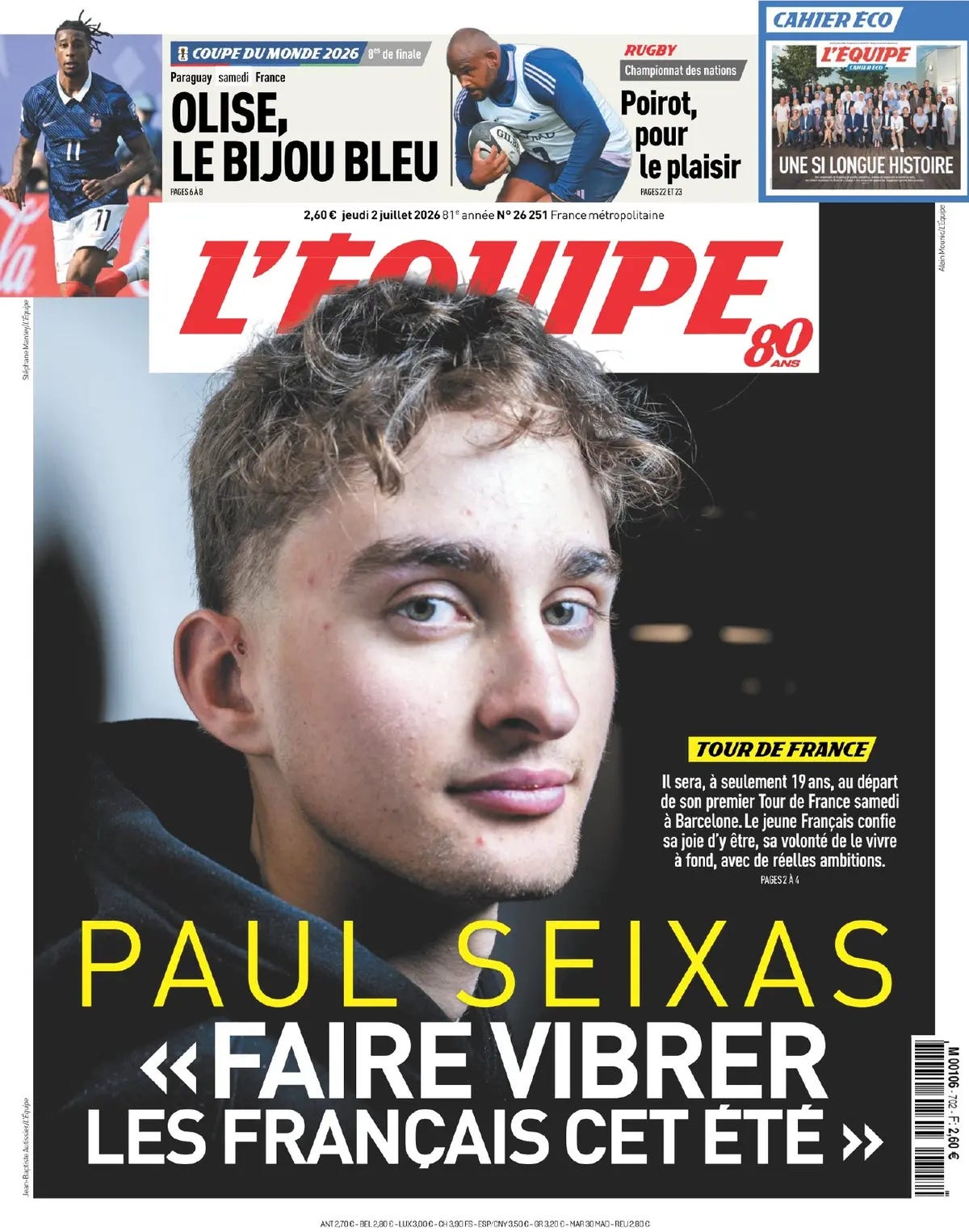
“I hope to thrill the French this summer,” Seixas said told French sports newspaper L’Équipe, which put him on the cover this week.
Seixas is stepping up at a time when French sports fans have much to celebrate. Kylian Mbappé ⚽ has already scored six goals for a French soccer team now considered the World Cup favorites. Victor Wembanyama 🏀 became a full-on NBA superstar this season, leading the Spurs to the NBA Finals in just his third season. France had a very successful Winter Olympics ⛷️ in Milan and will host the 2030 Games.
Theories abound as to why French cyclists (and French teams) have struggled so much in the sport’s biggest event. Some of it is definitely financial—as a handful of teams have dramatically increased the money they spend on talent, analytics and equipment, French teams have been largely left behind. There’s also a quirk of French labor law that requires athletes and staffers to be full-time employees, which creates a sizable tax burden that doesn’t hit other teams that treat theirs as part-time contractors. On top of that, some cycling experts believe French athletes and teams are culturally less willing to make all the sacrifices necessary to build a Grand Tour contender. By some twisted logic, that may also include an aversion to doping.
Urbanization? Too much work-life balance? Cruel fate? Much like Canadians pining for the return of the Stanley Cup, or Englishmen hoping this is finally the year football’s coming home, every French fan seems to have their own set of theories about why a maillot jaune on The Avenue de Champs-Élysées has proven so elusive.
Seixas is now the backbone of a much broader movement to change things (you could even call it a revolution). He’s currently employed by Decathlon CMA CGM, a French team that was sold in the middle of last year’s Tour de France. A French sportswear brand and retailer, Decathlon said at the time that it was planning to spend $47 million (40 million Euros) per year on the team—that’s still less than the biggest teams, but a dramatic jump up from the ~$33 million (€28 million) that the team and its French peers had spent in prior years. A few weeks later, French shipping and logistics giant CMA CGM signed on for five years, providing a sizable cash infusion4.
If you’re an MLB fan, think of Decathlon CMA CGM as the San Diego Padres. They’re not spending up with the sport’s top dogs, but they’re hoping to find success by investing more than the fat middle of their competition. Another point of comparison might be the New York Knicks, who just overcame their fans’ own concerns about cultural issues and curses to snap a decades-long drought. Bigger-spending teams outside of France will likely to try to poach Seixas if he doesn’t re-sign with Decathlon before next year, amping up the pressure.
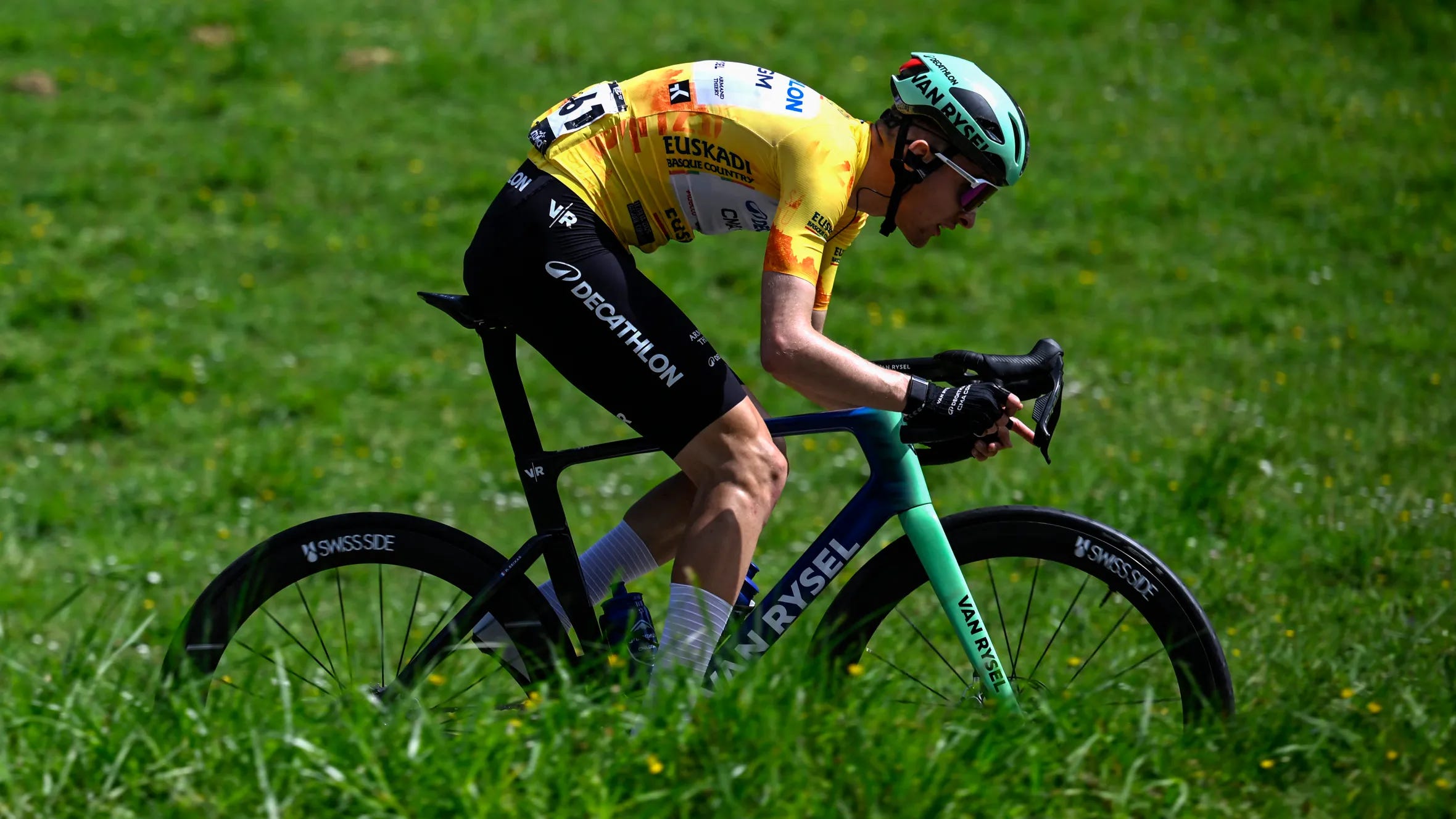
Though Seixas is the third favorite in the Tour de France, not many cycling experts are taking him seriously this year. The sport is currently dominated by two stars, one of whom (Tadej Pogačar 🇸🇮) will likely go down as cycling’s GOAT and the other (Jonas Vingegaard 🇩🇰) could otherwise have a legitimate claim. A bad crash seems to be the biggest impediment to Pogačar winning his fifth Tour de France.
But it’s unclear if French fans all see it that way. Speaking on a recent episode of The Cycling Dane podcast, former pro cyclist Jens Voigt, who won multiple Tour de France stages, gave Seixas some unsolicited advice.
“I would have a press conference—today or tomorrow—and go, ‘Dear friends, Dear nation, yes, I want to win the Tour and yes, I know you’ve waited for more than 40 years, and yes, I know it looks like I would have the potential. But not this year. Leave me alone. I’m still 19 years old. I might win a stage or two… But it’s my first grand tour and first Tour de France, not many people dare to do that,’” Voigt said. “I would go open communication.”
Seixas is taking a slightly different path. Asked this week whether he would risk his overall place in the race in order to pursue either a single stage win or some brief time in the yellow jersey, Seixas made it clear he was racing for the overall win, known in cycling as the general classification.
“The priority is the general classification,” he said. “What position that means, I do not know yet, I cannot tell you. But I would not take any risk for anything other than the general classification.”
The owners of his team were even more direct.
“Some people tell him, ‘You’ll win it in two years.’ I say: ‘Why not try now?,’” Rodolphe Saadé, the CEO of CMA CGM, said recently. “As a shareholder [of the team], do I set Paul Seixas the goal of winning the Tour de France? Of course I do, and I’ve told him so.”
Bonne chance, Paul!
Jacob’s Watch Report 📺: Though it wasn’t designed as such, cycling is the perfect sport for background viewing during the workday. Most of the 21 stages start around 7:30 a.m. and last four hours, but each is generally decided by a critical couple minutes—either the steepest part of a climb on a mountain stage or the final meters of a flat-course stage set up for the sprint specialists in the peloton. Otherwise, you’re greeted to casual commentary and beautiful scenes of colorful cyclists cruising through historic French towns, often cheered on by elated locals. The vibes are 10% UFC, 90% Great British Bake Off.
Every stage can be streamed on Peacock in the U.S., with some encore presentations of marquee days on NBC. The overall GC fight is expected to kick off during the first tough mountain stage on Thursday, July 9, but we’ll be watching from Saturday’s Grand Départ.

Club Sportico is a community organized by Sportico, a digital media company launched in 2020 to cover the business side of sports. You can read breaking news, smart analysis, and in-depth features from Eben, Jacob and their colleagues at Sportico.com, and listen to the Sporticast podcast wherever you get your audio. Contact us at club@sportico.com.
That’s, in calendar order: the Giro d'Italia, the Tour de France, and the Vuelta a España.
We expect this to change a bit in the coming years. The two favorites in this race are 27 and 29 years old, respectively, and they’re considered elder statesmen.
Cities outside France pay million of dollars to host the first few stages of the Tour de France, which is called the Grand Départ.
Like almost every other major global sport, cycling has been upended in recent years by deep-pocketed investors—a mix of billionaires, businessmen, and sovereign wealth funds. The top team for the past few years is backed by UAE; the next richest by a Norwegian software giant.