

Prediction Markets Are Betting Against You
Plus: An AI mishap, new NHL economics and a lumpia pop-up in Toronto.

This is supposed to be one of the quietest stretches in the calendar. But in a year stuffed with sports, there’s a lot going on…
Sportico Story of the Week 📉: The meteoric rise of Kalshi, the biggest prediction market in the U.S., has by now reached millions of Americans. Many of them understand the basic way the business operates—it’s a marketplace that matches buyers and sellers, and takes a fee on the transactions.
Far fewer likely understand the other major pillar of Kalshi’s business. The company also has what’s called a market maker, a trading desk that bets against its customers on its own platform. Kalshi is far from alone in the set-up. DraftKings, Fanatics and Novig are among those with similar structure.
While these market makers do serve a valuable function—they provide liquidity on the platform, making the user experience more robust—its not hard to see the potential conflicts. If you recall the rise and fall of Sam Bankman-Fried’s FTX, much of that fraud stemmed from the intertwined relationship between the company’s cryptocurrency exchange (FTX) and its affiliated trading arm (Alameda Research).
DraftKings CEO Jason Robins has been publicly optimistic about his company’s market maker. In February, he called the set-up a second “revenue engine” for its predictions platform. In a call with Sportico last week, he said the unit was already profitable, praised it as “super high margin,” and highlighted the opportunity to also do business on other people’s exchanges.
“That’s the interesting thing,” Robins said. “Imagine if we could go on another company's sportsbook and capture a piece of their customer economics. That’s sort of what you’re seeing here. We can go on any exchange and use the same exact capabilities—the pricing algorithm, the trading apparatus—to be able to make money. That gives us a piece of everybody’s pie, so to speak.”
Earlier this month the CFTC, which regulates prediction markets, proposed rules that would limit the upside of market makers participating on their own exchanges. In a long feature we published Friday, our colleague Dan Bernstein dove into the relationship between prediction market platforms and these affiliated trading arms. It’s worth a read if you’re curious about the other, less-discussed parts of these businesses.
AI-pocalypse of the Week 🚲: Dutch cyclist Demi Vollering won her second Tour de France Femmes on Sunday, riding away from her main rival in the race’s final stage. Afterwards she posted a finish-line photo on her Instagram, finger pointing to her helmet, yellow jersey proudly displayed.
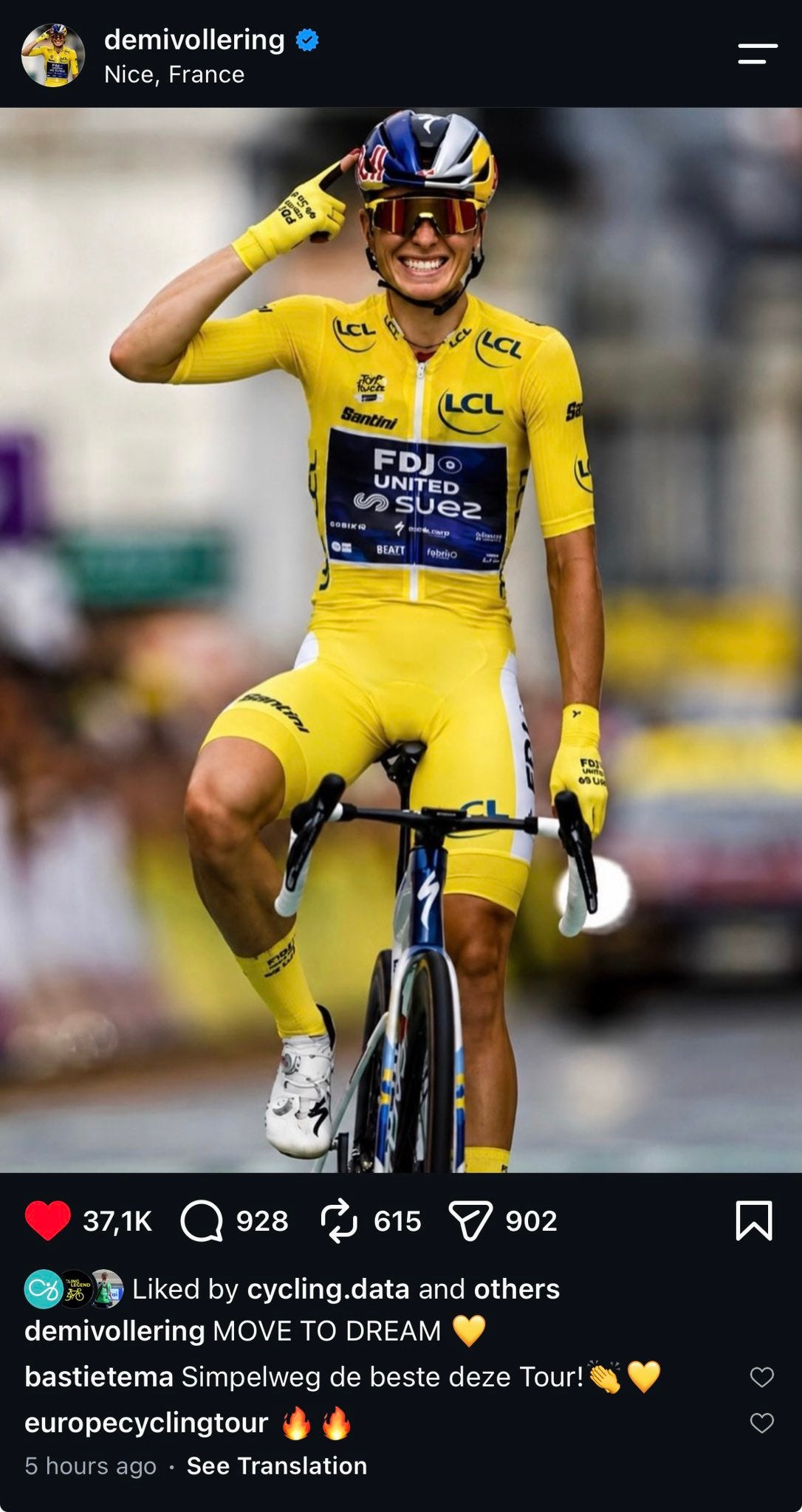
Users quickly noticed that the photo she posted had been touched up with AI. Normally we wouldn’t care, but in doing so, the sponsor logos got all jumbled. Here, via X user @lucxsronald, is a side-by-side. Look at the logos toward the bottom of the kit.
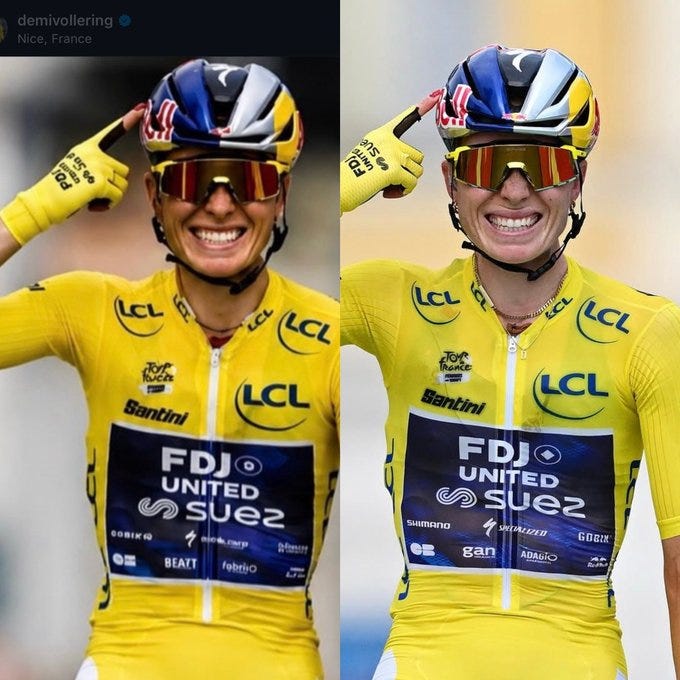
I have no clue if this was intentional or not, but I feel very confident that executives at those companies, and maybe even within her own team, were not happy.
Food of the Week 🎾: I’m willing to guarantee that the WTA tournament underway in Toronto was not originally planning to serve lumpia last week. But the Canadian Open began selling the fried spring rolls in a pop-up to serve the tidal wave of Filipino fans that flocked to see 21-year-old sensation Alex Eala. I often criticize sports teams and events for being too rigid in their thinking—this is a good example of the opposite!


By the way, we’ll likely have more to say on Eala in a later post. It’s still early of course, but we may be witnessing the meteoric rise of a sporting (and marketing) sensation.
Clown of the Week 🤡: Enes Kanter.
Non-Sportico Story of the Week 🏒: The NHL’s highest-paid player is a 20-year-old who has been in the league for just two seasons. Macklin Celebrini’s new five-year, $94 million deal with the San Jose Sharks is the latest data point in a tectonic shift in how NHL teams approach their payrolls.
James Mirtle recently unpacked it all in a great explainer on The Athletic. The levers here include an increase in competitive offer sheets, new salary cap projections, looming media negotiations and savvier agents.
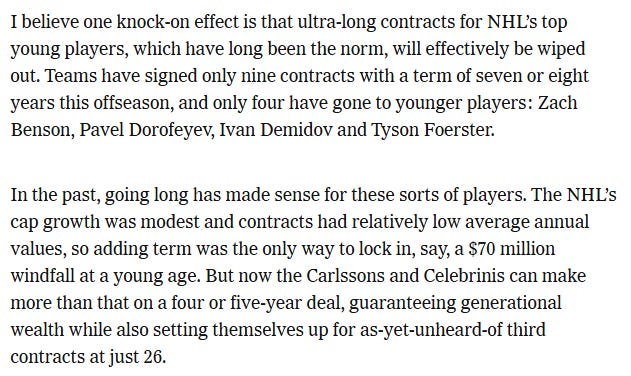
Tweet of the Week 💰: We’ve already documented the many different ways in which tech billionaire Vinod Khosla, the man purchasing the Seattle Seahawks, is ideologically different from basically every other NFL owner.
Well here’s an X post from the weekend 👇 Remember, the NFL is structured to virtually guarantee hundreds of millions in annual profit for many owners.



Club Sportico is a community organized by Sportico, a digital media company launched in 2020 to cover the business side of sports. You can read breaking news, smart analysis, and in-depth features from Eben, Jacob and their colleagues at Sportico.com, and listen to the Sporticast podcast wherever you get your audio. Contact us at club@sportico.com.