

The USMNT Hot Seat is Scorching 🔥
For so much of the U.S. soccer industry, there’s millions (maybe billions) riding on the success of America’s inconsistent men’s national team.

Welcome back to Club Sportico, where we discuss the intersection of sports and money—with some extra humor and opinion. Today we’re asking: Do you believe that we will win?
Soccer romantics love to say that the hopes of an entire nation ride on its national team during the World Cup. Those people, I contend, haven’t spent much time in America.
But while the U.S. men’s national team (USMNT) might not have the cultural heft of Les Bleus in France, the Black Stars in Ghana or Seleção in Brazil, the squad opens play Friday against Paraguay carrying a unique financial pressure, one larger than almost any other team in the world.
That’s because the entire multibillion-dollar enterprise of soccer in America is increasingly looking toward the USMNT, which has struggled over the past year, to solve a problem they didn’t expect to have in June 2026. The men’s World Cup is the biggest sporting event in the world, and yet many local fans need something to pull attention away from visa problems, ticket prices, transportation fears, empty seats, and the Trump-FIFA bromance.1 The USMNT is their best hope.
U.S. coach Mauricio Pochettino was asked this week about connecting with casual U.S. sports fans. He spoke first about playing with passion and building an emotional connection with Americans. Then he shifted to the real issue. “But we need to win,” he added. “The important thing is to win.”
Soccer has occupied a strange place in American sports since the U.S. last hosted this event in 1994. It’s tremendously popular as a participation sport—second only to basketball among team activities2—and it has a very loyal following among many Americans, particularly younger ones.
Contrary to what the talking heads say, this is very much a soccer country. And yet everyone associated with the sport in the U.S. believes there is much broader appeal (and a much bigger business opportunity) simmering just below the surface, waiting to explode if given the right spark.
Enter the 2026 FIFA men’s World Cup. For the past decade, many of those people have spoken optimistically about this moment, with 78 of the event’s 104 games being held across eleven different U.S. cities. It’s been baked into the thesis for basically everyone who recently bought into Major League Soccer. It’s launched investment funds and new media companies; hospitality businesses and real estate development.
But the run-up to this event has been rough. The tight relationship between U.S. President Donald Trump and FIFA President Gianni Infantino has turned off many fans.3 Others balked at the sky-high ticket prices. In New York, there’s been far more talk about visa issues and public transportation concerns than there has been about the soccer itself. The six-week tournament kicked off Thursday to tepid U.S. buzz.
The eyes of the nation might not be on USMNT, but the eyes of the U.S. soccer industry sure are.
Consider MLS. There are 45 MLS players in the World Cup, and only eight of them are on the USMNT, but the league is banking on a surge of new interest in soccer across the country. That only happens if the World Cup’s group stage resonates with casual fans.
“We’re working with our teams’ chief business officers on a weekly basis, talking about the countdown to the World Cup and how we can be sure that everybody knows we’re here,” MLS commissioner Don Garber said recently on our Sportico Sports Business television show. “How do we capture the momentum of the world’s largest event, and on the day it’s over say, ‘Thanks world, we’ll take it from here.’”
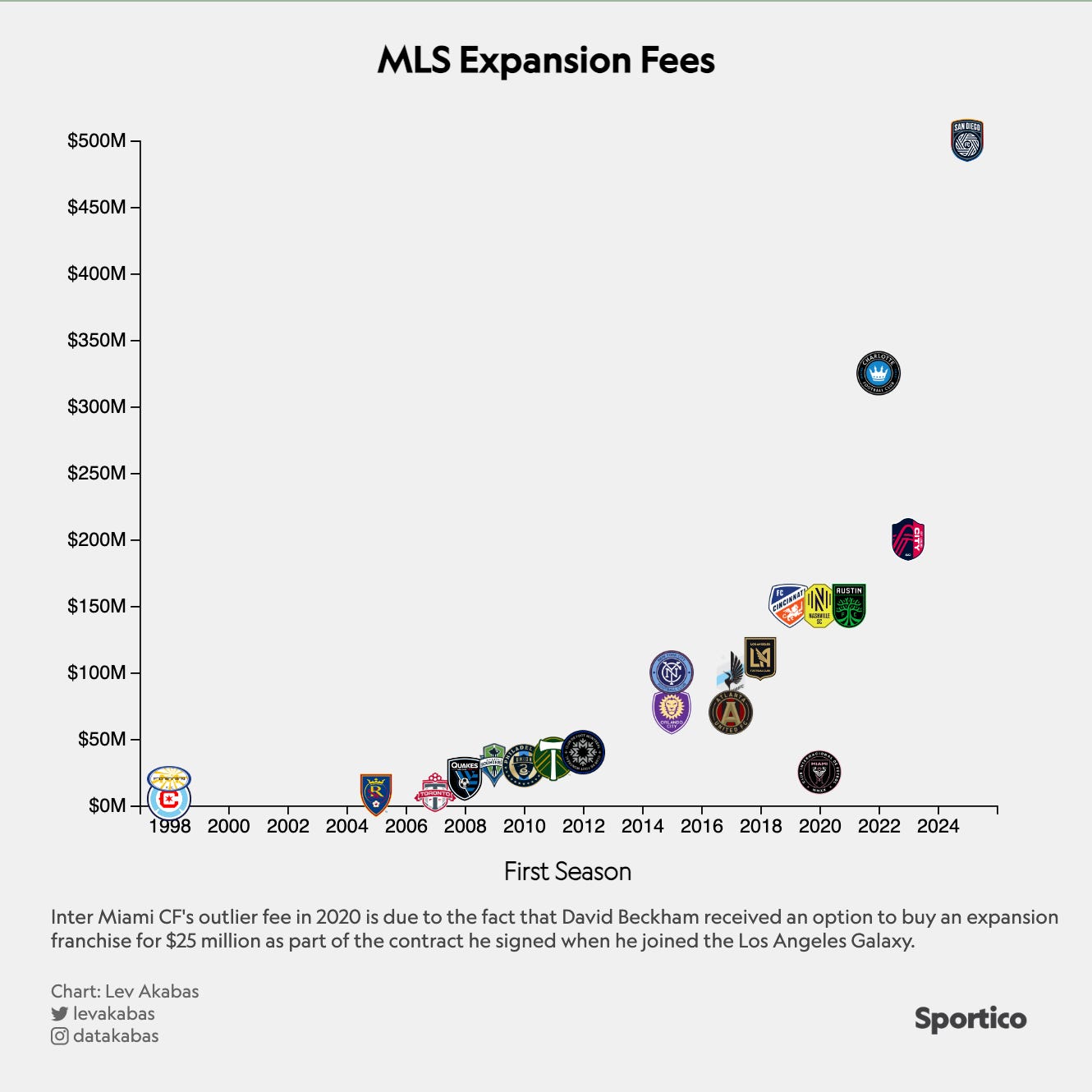
(For what it’s worth, while I’m not convinced there’s a business boom coming for MLS on the back of this World Cup, it’s definitely true that the league has already reaped a business boom from the anticipation of the event. MLS valuations have grown 220% in the eight years since North America was awarded hosting honors. Expansion fees to join the league have jumped from $70 million to $500 million.)
Others across the U.S. soccer landscape are in a similar place. Youth sports may be the hottest investment sector in U.S. sports, and soccer is a juggernaut. About 2.5 million kids in America play soccer, a wide swath that covers town rec leagues all the way through elite academies and high school programs. Many expect that number to grow on the back of a successful World Cup, particularly if young Americans are inspired by the USMNT.
It’s true for media companies, too. Fox very notoriously received a hefty discount to broadcast this World Cup, paying less than $500 million for rights likely worth 3x that much4, but there’s no doubt that a good U.S. run would work wonders for ratings and advertising deliverables. The most-watched group stage match in American history was the USMNT win over Portugal in 2014. The next most-watched was USMNT vs. England in 2022. If you look deeper down the list, the trend is clear—the men’s team draws outsized group stage audiences when there’s reason for fans to tune in.
In hopes of stirring excitement, Fox recently ran a commercial that envisioned the team… winning the entire tournament!5
If you’re heavily reliant on the U.S. team’s success, there are myriad reasons for concern. The team made a big coaching splash last year with Pochettino but has been pretty mediocre in its tune-ups for this World Cup. The USMNT is winless in its last 10 matches against European nations, including blowout losses to Belgium (5-2) and Switzerland (4-0). By some metrics, the team has regressed over the past few World Cup cycles. The U.S. entered the 2006 World Cup as the No. 5 team in FIFA’s global rankings. It enters this event as the No. 17.
But there’s also good news. This is a bigger tournament, 48 teams instead of 32, and twice as many nations will advance to the knockout stage. As a host, the U.S. was automatically made a Pot 1 country, guaranteeing there wouldn’t be another Top 10 team in its group. The rest of the group is fine—Paraguay and Turkey are decent teams and Australia was the lowest-ranked team the U.S. could possibly have drawn from Pot 3.
All in all, it’s a remarkably easy group for a host nation ranked outside the Top 15. Barring an absolute disaster, this team will make the knockout stages. After that, anything can happen.
My head tells me the U.S. squad won’t play much longer than that point. But if you’re looking for optimism, watch this absolute screamer from Antonee Robinson 👇
Jacob’s 🔥 Take: U.S. soccer saw a big bump from hosting the 1994 World Cup, but it was also a lot harder to follow other leagues back then. Surely Americans will fall in love with Robinson or Tim Weah this summer, but many others seem destined to become enamored with Spain’s Yamine Lamal or England’s Jude Bellingham. And between social media and streaming, it’ll be much easier to follow them back to their domestic leagues this fall.

Club Sportico is a community organized by Sportico, a digital media company launched in 2020 to cover the business side of sports. You can read breaking news, smart analysis, and in-depth features from Eben, Jacob and their colleagues at Sportico.com, and listen to the Sporticast podcast wherever you get your audio. Contact us at club@sportico.com.
A Knicks Finals run has also taken some oxygen away from futbol, at least in New York
According to the SFIA, 32 million Americans played basketball in 2024. Soccer’s participation was 20.4 million, followed by baseball (17.3 million) and volleyball (10 million).
The official World Cup draw, where Infantino awarded President Trump the inaugural FIFA peace prize, was held at the Kennedy Center in D.C. in December. In the ensuing months, Trump renamed the venue in his honor, authorized a raid that captured Venezuelan president Nicolas Maduro, then helped launch a global war with Iran.
The full story, which my former colleague Tariq Panja recently outlined in the New York Times, is pretty wild.
I love that it’s not too much to stage the USMNT winning the World Cup, but it IS too much to show viewers which specific player might score the winning goal.