

It’s Time To Kill the World Cup’s Zombie Matchup
England vs. France would normally be must-watch. On Saturday, it's an afterthought.


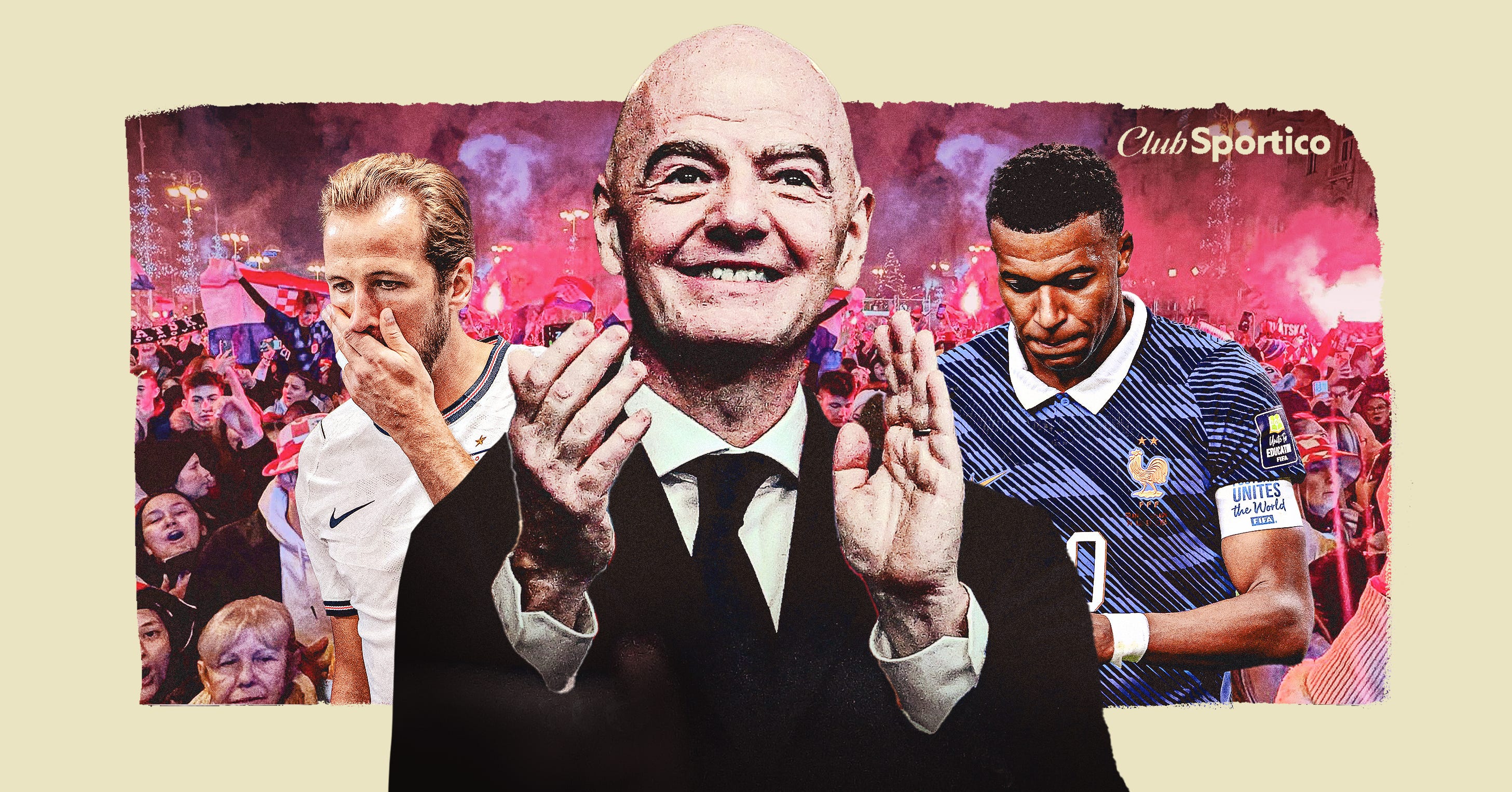
Welcome back to Club Sportico, where we discuss the intersection of sports and money—with some extra humor and opinion. Today we’re talking about the World Cup’s worst game.
England was knocked out of the World Cup in painful fashion on Wednesday, surrendering two goals in the final 15 minutes of its semifinal clash with Argentina. Making matters more painful? The Three Lions weren’t actually “knocked out.”
A day before, France surprisingly exited stage left in a 2-0 defeat to Spain. But Les Bleus can’t go home either.
Instead, France and England will square off on Saturday in Miami—a clash of zombies in the World Cup’s third-place game, or what FIFA is trying to brand as “the bronze final.”
“None of our players and none of the French players want to play this match,” England coach Thomas Tuchel told reporters this week. “They want to play the final. We gave everything to achieve that. Everyone plays to win the World Cup, but that’s how it is.”
The match is not a pure exhibition. In FIFA’s team ranking formula, the third-place game has the same weight as the final played the following day. Goals scored count in the Golden Boot race1, and the winning team comes away from the World Cup $2 million richer.
Smaller countries have cherished podium finishes. Here’s how the Croatian squad celebrated after its 2-1 win over Morocco four years ago
But this game is not a must-win—especially for former champions like England and France. The annual soccer schedule is already jam packed, each additional 90 minutes carries more injury risk, and most of these players star on club teams whose seasons kick off in a month.
For soccer newbies, you can think of it like a non-CFP New Year’s bowl game. Like those battles, some top players are expected to sit or get subbed out over the course of the match. In the hours after Argentina’s comeback, when it became clear that Saturday’s tilt wouldn’t be Lionel Messi’s World Cup swan song in his adopted hometown, ticket prices cratered. The get-in price has dropped by more than 50% over the last three days, to $625 as of Friday morning, cheaper than any of the six group stage matches England and France contested. And dropping.
American tourneys used to have similar events—until they were killed amid sagging interest. The NFL’s third-place game in the 1960s was not-so-affectionately called the Loser’s Bowl or Toilet Bowl, and yes it was played for a few years after the Super Bowl was created. Virginia defeated LSU in the NCAA’s last men’s basketball third-place affair in 1981.2
While those games generated extra revenue and playing time in leagues’ early years, tournament expansion solved both problems more effectively. Involving more teams in the postseason proved significantly more interesting—and lucrative—than having more postseason for the same number of teams.
FIFA is slowly learning that lesson. It expanded to 24 teams in 1982 and 32 in 1998. This summer was the first with 48 teams and an additional knockout round. In 1934, teams played three matches in a 16-country tourney before the third-place final3. In 2026, England just played seven matches in less than a month. After a grueling league season, it’s understandable if stars don’t want to compete in a only-kinda-meaningful finale.
If the World Cup expands to 64 teams, the third-place game will feel even more unnecessary—and cruel.
The other side of this argument, of course, is that people will watch. The consolation match from the 2022 World Cup, a 2-1 Croatia win over Morocco, kicked off at 10 AM ET and drew 4.3 million viewers on Fox, plus another 2.7 million viewers on Telemundo. That’s 7 million people in America4, plus countless more around the globe. It was probably one of the most watched sporting events globally in the past four years. This year’s game will undoubtedly attract larger numbers.
And you’re not wrong for watching the latest (and possibly last?) installment of the bronze final on Saturday (5 p.m., Fox & Telemundo). It is still the World Cup, after all. It’ll be gone before you know it.

Club Sportico is a community organized by Sportico, a digital media company launched in 2020 to cover the business side of sports. You can read breaking news, smart analysis, and in-depth features from Eben, Jacob and their colleagues at Sportico.com, and listen to the Sporticast podcast wherever you get your audio. Contact us at club@sportico.com.
Just Fontaine holds the record for most goals in a World Cup with 13. Left unmentioned: four of them came in the 1958 consolation match.

The U.S. team’s third-place finish in 1930 was decided by a tiebreaker, not by a consolation game against fourth-place finisher Yugoslavia.
To show how much U.S. viewership for the World Cup has grown, the 2014 third-place game, which was played at the exact same time between England and Belgium, drew a combined 4.6 million U.S. viewers.