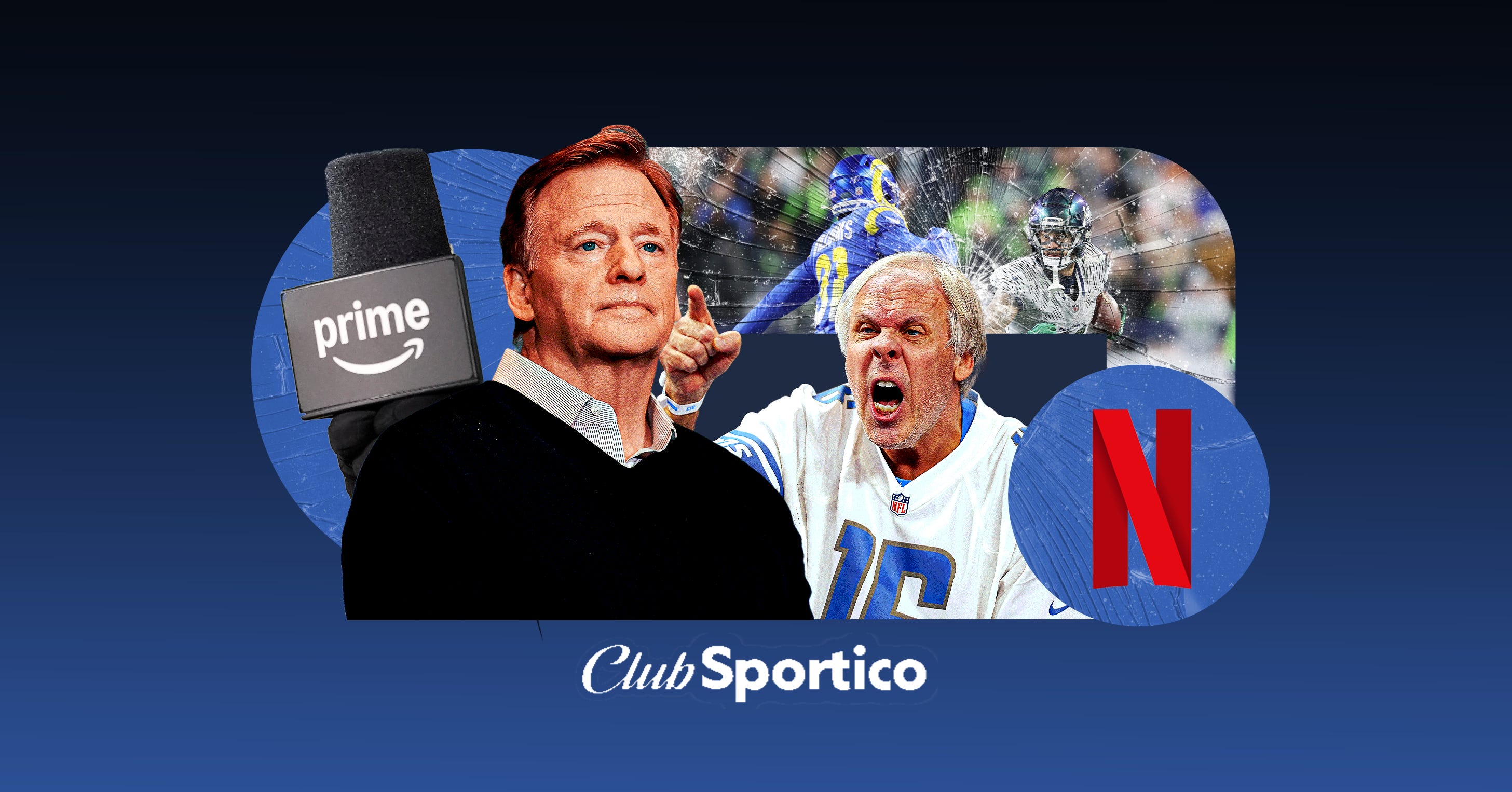
The NFL’s TV Talks Are Even More Perilous Than They Look
A doom loop awaits sports leagues who stretch their fans too far with split media deals. Here's what could happen.
Welcome back to Club Sportico, where we discuss the intersection of sports and money—with humor and opinion. Today we’re talking about worst-case scenarios 😬.
Over the weekend, former ESPN president John Skipper went viral for his take on the delicate tightrope act underway by the NFL in its newly launched media negotiations. Skipper’s argument, made on an episode of Pablo Torre Finds Out, was that the world’s richest sports league could be in trouble if it becomes too reliant on Amazon and Netflix to pay up for its media rights, because those tech giants don’t need live sports as much as traditional networks do.
The bad-case outcome for all leagues, not just the NFL, is actually scarier than the “dangerous scenario” Skipper outlined. More than billions in media revenue are at risk in the transition to streaming. There’s a potential doom loop 🌀 awaiting sports who aren’t careful.
Here’s what could happen to your favorite pro league … and then what the NFL, specifically, is doing to avoid it. Let’s get speculating!
Six Potential Steps To Become Irrelevant 📉
Leagues need to expand their national TV income, particularly the MLB/NBA/NHL as they face declines at the local level. But existing legacy partners, besieged by online alternatives, can only pay so much. Fox Corp.’s market cap is $26 billion, making it 1/14th the size of Netflix. The rational response is to expand the number of distribution partners, especially today with digital players hungry for a cut of the action. MLB games now air on nine national networks/apps. Same with the WNBA.
Naturally, that’s going to turn off some fans. Many will jump through hoops to watch, but, if the expansions continue, more casual followers will either get annoyed by the rising costs of viewership or stop caring enough to check when and where events are on. New media partnerships beget new fans, though the question remains over how committed those neophytes turn out to be. There’s a growing convenience gap between sports fandom and other forms of entertainment that offer endless, free hours of distraction at the touch of a single button. Stretch fans too far and they will snap.
However, leagues are not built to shrink. Player-owner labor peace is largely built on sharing a consistently growing financial pie. Teams are willing to lose money year-to-year as long as their franchise values rise. The Big Four leagues have shrunk once in the last 70 years. Opening the door for competitor leagues or losing games to CBA fights on top of theoretical viewership slides would only further threaten their already shaky standing.
So there’s only one option if fanbases shrink due to a fractured media deal: Fracture it further. Add more partners. Sell highlight rights. Pitch it to fans as increasing the number of ways the sport can be watched, even if it also increases the amount of confusion and frustration.
Of course, that’s only going to turn more fans off. And as sports shrink, you get a lot of arguments about why. It’s the players’ fault; or the owners’. It’s got something to do with politics, or something inherently wrong with the sports’ rules. Change them and more people complain. Most likely, there’s simply other things for people to watch—and the alternatives are easier to follow.
The gravity of the situation can’t be ignored forever. Slowly, then all at once, there are only diehards left. Eventually, they die too.
Look what happened to boxing. Or, outside of sports, what Marvel’s movie series is currently trying to come back from. Over-expansion comes with a cost. Rising prices make alternatives more compelling. Every scandal thereafter feels close to existential.
The NFL knows all this. Here’s what they’re doing to avoid any slippage. 📈
The NFL has ingrained itself with the biggest streaming apps: YouTube, Netflix, Disney, Prime Video and Peacock. That keeps the league top-of-mind for people who turn to those services first when looking for entertainment. And there’s a chance that Prime/Netflix/YouTube do end up needing the NFL in a similar way to the current networks. Surely each would see a wave of cancellations if they lost pro football.
At the same time, the league isn’t abandoning broadcast networks. (In part, this is due to the law that gave them a legal monopoly.) Every team’s local games are carried on over-the air networks. It’s not confusing—or expensive—for a Buccaneers fan in Tampa Bay to follow their team. For many people, it’s actually simpler than managing their other entertainment.
In fact, the league is now partially propping up its long-time media partners. Earlier this year the NFL and ESPN closed a $3 billion tie-up that gave the latter ownership of NFL Network and gave the former a 10% stake in ESPN. The NFL was instrumental in ESPN’s rise through the 1980s and 1990s and that deal (and the relationship it locked in place) likely helps ensure the league will continue to have at least one viable negotiating partner to play against the tech giants.
Like other leagues, the NFL has also found one potential growth area: international fans. It’s slow-going in certain places, but there’s a clear investment in growing the game globally, including with flag football. That has the potential to make the league’s rights valuable to streamers looking to expand in far-flung markets—and give teams new lines of revenue to make up for any potential domestic shrinkage, a playbook already underway for major European soccer leagues that have reached saturation in their home countries.
Yes, it is increasingly complicated to follow the NFL. Yes, there are more alternatives out there now… and new ones every day. But amidst all that chaos—new apps and channels and leagues and creators—if the NFL can remain easy-to-find for fans and an increasingly rare guaranteed source of attention for media companies, football won’t need to worry about doom.
It’ll be too busy growing even bigger.
Club Sportico is a community organized by Sportico, a digital media company launched in 2020 to cover the business side of sports. You can read breaking news, smart analysis, and in-depth features from Eben, Jacob and their colleagues at Sportico.com, and listen to the Sporticast podcast wherever you get your audio. Contact us at club@sportico.com.


Good read. The needle the NFL & NBA are threading is how to make extra money from Amazon and Big Tech without ending up like Amazon’s retail third party sellers where Amazon becomes the only game in town to monetize. Other big Amazon partners have gotten chewed up by this… …see for ex UPS.